Physics ranks among the most demanding subjects to learn without an instructor. The discipline requires simultaneous mastery of abstract concepts, mathematical formalism, and experimental intuition – three skills that traditional classrooms deliver through lectures, office hours, and lab sessions. Remove those, and a self-learner faces a real structural problem: where does the feedback come from?
The answer, in 2025, is a combination of open courseware, simulation platforms, AI-driven solvers, and curated problem banks that collectively replicate – and in some areas surpass – the traditional classroom loop. A student working through rotational dynamics at midnight can now run a virtual experiment, consult a step-by-step AI breakdown, and cross-reference a university-level problem set, all without spending a dollar.
One tool worth bookmarking early is Physics AI, an AI solver that generates step-by-step explanations across mechanics, electromagnetism, thermodynamics, optics, and quantum physics. It accepts both typed input and photo uploads of handwritten problems – a practical detail when you are working through a printed textbook and hit a wall. Its value for self-study lies not in the final answer but in the derivation chain: each solution identifies the relevant physical law, shows formula selection, and walks through unit-level algebra.
This guide organizes the strongest available resources by function: foundational knowledge, visual and interactive tools, problem-solving infrastructure, and study methodology.
What Do You Need Before Starting to Self-Study Physics Online?
A reliable self-study attempt starts with two things: sufficient math fluency and a sequenced plan. Without both, most learners stall within the first month.
What Math Prerequisites Should You Have Before Learning Physics?
Algebra-based physics (the standard introductory tier) requires fluency in algebra, trigonometry, and basic vector operations. Calculus-based physics – the track used by engineering and physical science majors – adds single-variable calculus (derivatives and integrals) as a hard prerequisite. Multivariable calculus and linear algebra become necessary at the intermediate and advanced levels (electrodynamics, quantum mechanics).
A practical self-test: if you can comfortably solve a system of two linear equations, decompose a vector into x and y components, and interpret the slope of a curve, you are ready for introductory physics. If not, Khan Academy’s precalculus and trigonometry tracks close that gap in roughly four to six weeks of daily work.
How Do You Build a Self-Study Roadmap Without a Teacher?
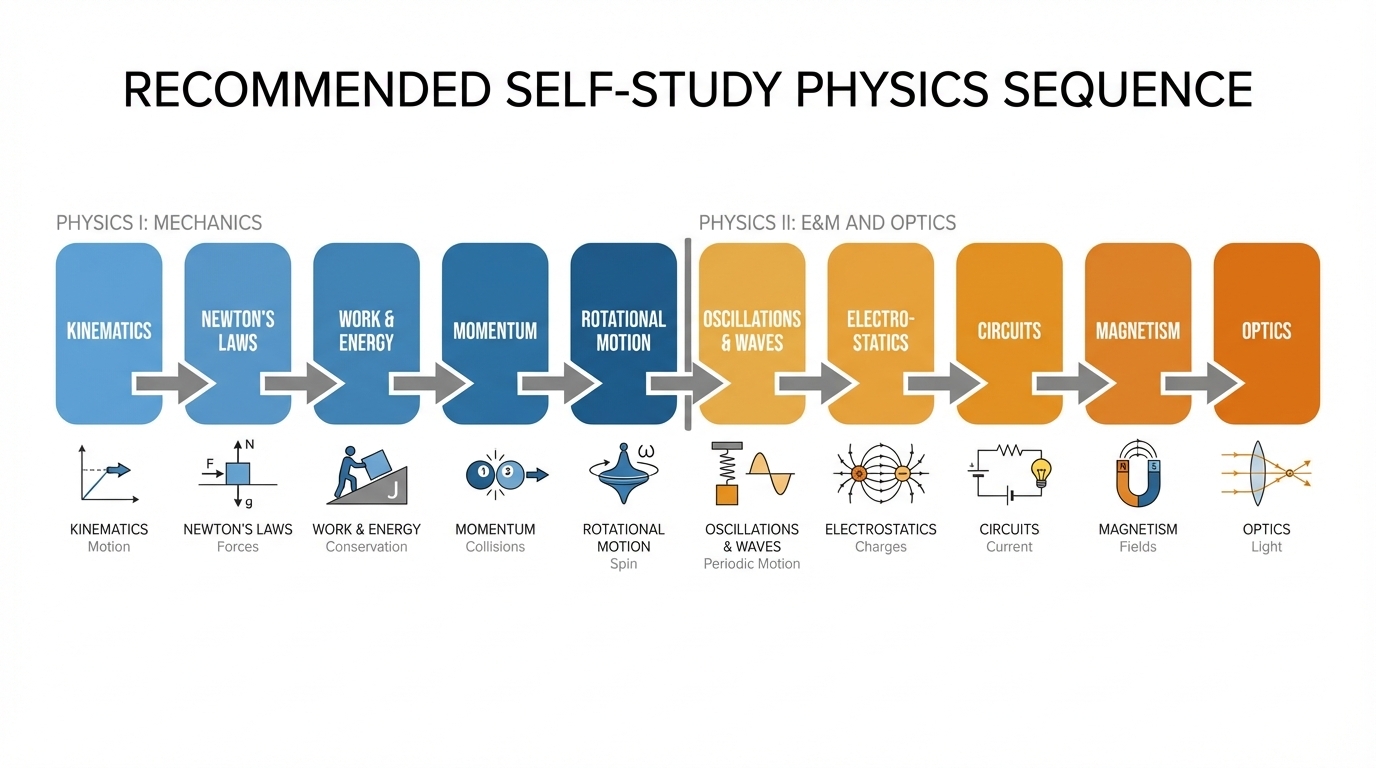
The most reliable approach is to adopt an existing university syllabus rather than invent your own sequence. MIT OpenCourseWare publishes full syllabi, lecture schedules, and problem sets for both Physics I (8.01 – classical mechanics) and Physics II (8.02 – electromagnetism). Following this sequence – kinematics → Newton’s laws → work and energy → momentum → rotational motion → oscillations → waves → electrostatics → circuits → magnetism → optics – mirrors how the subject is taught at research universities for a reason: each topic builds directly on the prior one.
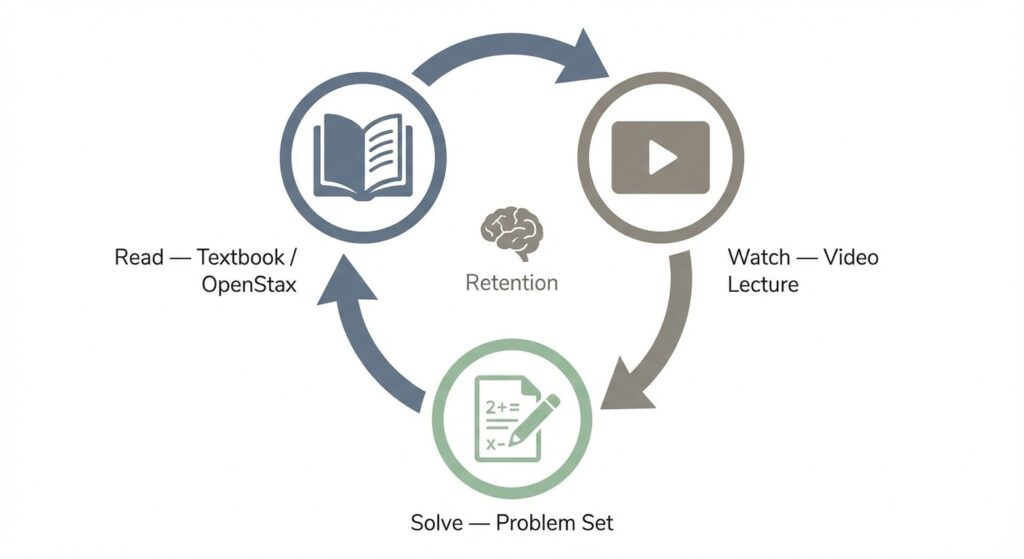
Pair each unit with three resources: a textbook chapter for formal exposition, a video lecture for intuition, and a graded problem set for active practice. Skip any one of these three, and retention drops sharply.
What Are the Best Free Online Courses for Learning Physics From Scratch?
Three platforms dominate free physics instruction, each serving a different depth and learning style.
MIT OpenCourseWare (OCW) provides the most complete free physics education available online. The 8.01 and 8.02 courses include video lectures by Walter Lewin (archived) and subsequent instructors, typed lecture notes, problem sets with full solutions, and past exams. The material targets university freshmen and assumes calculus fluency.
Khan Academy covers physics from the conceptual level through AP Physics 1 and 2. Its strength is granularity: each topic is broken into short (8–15 minute) videos with embedded practice exercises that offer instant feedback. For learners without calculus, this is the most efficient starting point.
Coursera and edX host structured courses from institutions including Rice University, University of Virginia, and CERN. Audit tracks are free; verified certificates require payment (typically $50–$100). The advantage here is instructor-paced structure with deadlines and peer forums – useful for learners who need external accountability.
How Does Khan Academy Compare to MIT OCW for Physics?
| Dimension | Khan Academy | MIT OCW |
| Target level | High school / AP | University (calculus-based) |
| Math requirement | Algebra, basic trig | Single-variable calculus |
| Format | Short videos + interactive exercises | Full lectures + problem sets + exams |
| Feedback mechanism | Built-in auto-graded practice | Self-graded (solutions provided) |
| Best for | Building conceptual foundations | Rigorous, exam-ready preparation |
Learners switching from Khan Academy to MIT OCW should expect a significant jump in mathematical demand. Completing Khan’s AP Physics 1 content before starting MIT 8.01 is a productive bridge.
Are Free MOOC Certificates in Physics Worth Anything?
Free audit-track certificates carry no verified identity and minimal formal value. Verified certificates from Coursera or edX hold more weight: they confirm identity via webcam and appear on LinkedIn profiles. They will not substitute for university credit in most admissions processes, but they demonstrate self-directed initiative – a signal that graduate admissions committees and technical employers do notice.
Which Video Channels Explain Physics Most Clearly?
Video lectures serve a specific function in self-study: they build physical intuition that textbooks often assume. The best channels separate into two categories – conceptual and curriculum-aligned.
Conceptual channels (for intuition and deeper understanding):
- 3Blue1Brown – mathematical animations applied to physics topics; especially strong on linear algebra and calculus connections to physical systems.
- Veritasium – focuses on counterintuitive physics phenomena with experimental demonstrations.
- MinutePhysics – short-form explanations that clarify specific conceptual misunderstandings.
Curriculum-aligned channels (for structured, topic-by-topic learning):
- Professor Dave Explains – covers physics from introductory mechanics through modern physics in textbook-sequential order.
- Michel van Biezen – contains thousands of individually solved physics problems, organized by topic, effectively functioning as a video problem-set companion.
- Lectures by Walter Lewin (archived MIT recordings) – widely regarded as among the clearest university-level physics lectures ever recorded.
What Order Should You Follow When Watching Physics Lectures?
Follow the standard Physics I → Physics II sequence: kinematics, forces, energy, momentum, rotational dynamics, simple harmonic motion, waves, then electrostatics, DC/AC circuits, magnetism, electromagnetic waves, and optics. Attempting quantum mechanics or thermodynamics before completing mechanics is a common self-learner mistake that leads to frustration and gaps.
Where Can You Find Quality Physics Textbooks for Free?
OpenStax publishes two peer-reviewed, openly licensed physics textbooks: University Physics (calculus-based, three volumes) and College Physics (algebra-based, two volumes). Both are available as free PDFs and in a browser-readable HTML format that loads on low-bandwidth connections.
The Feynman Lectures on Physics, originally published in 1964, are freely accessible at caltech.edu. They are not a substitute for a standard textbook – they contain fewer worked examples and problem sets – but they remain unmatched for developing physical intuition, particularly in electromagnetism and quantum mechanics.
HyperPhysics (Georgia State University) takes a different approach: it presents physics as an interlinked concept map, where each topic connects visually to related principles. It is most useful as a quick-reference lookup rather than a linear reading resource.
How Does OpenStax Compare to Traditional Textbooks Like Halliday & Resnick?
OpenStax covers the same canonical curriculum and has undergone formal peer review. Where Halliday, Resnick & Walker holds an advantage is in the density and difficulty of its end-of-chapter problems, which include more multi-step, conceptually layered exercises. Self-learners using OpenStax can compensate by supplementing with MIT OCW problem sets, which match or exceed Halliday-level rigor.
Can You Do Real Physics Experiments Without a Physical Lab?
PhET Interactive Simulations (University of Colorado Boulder) offers over 50 physics simulations covering mechanics, waves, electricity, thermodynamics, and quantum phenomena. Each simulation allows direct manipulation of variables – adjusting friction coefficients, changing voltage, altering gravitational field strength – and provides real-time visual output. PhET simulations run in a browser and are free.
oPhysics focuses specifically on mechanics and electromagnetism simulations with precise numerical readouts, making it suitable for verifying calculated answers against a visual model.
Algodoo allows users to build custom 2D physics environments (ramps, pulleys, fluids, gears) and observe how Newtonian mechanics plays out in real time. It is particularly useful for developing intuition about constraint forces and mechanical advantage.
Do Virtual Labs Meet Academic Requirements for AP or IB Physics?
The College Board requires hands-on inquiry-based lab investigations for AP Physics, and the IB program mandates documented experimental work. Neither officially accepts virtual-only labs as a full substitute. However, many AP and IB teachers use PhET simulations as supplementary or preparatory activities. Some accredited online high schools have built lab curricula around simulations combined with at-home experiments using low-cost materials (smartphones as accelerometers, for example). Check specific program requirements before relying exclusively on virtual labs.
How Can AI Tools Help You Actually Understand Physics – Not Just Copy Answers?
The risk with any solver is obvious: copying a final answer teaches nothing. The pedagogical value of AI physics tools lies entirely in the intermediate steps – the identification of which law applies, the reasoning behind formula selection, and the algebraic manipulation connecting setup to solution.
Effective use follows a specific pattern: attempt the problem yourself first, get stuck at a particular step, then consult the AI breakdown to identify precisely where your reasoning diverged. This targeted feedback loop – isolating the exact point of confusion – is what makes AI-assisted study meaningfully different from reading a static solution manual.
What Should You Look for in an AI Physics Solver?
Not all AI solvers are equally useful for learning. Prioritize tools that:
- Show full derivations, not just final numerical answers
- Name the physical law or principle applied at each step (e.g., “applying conservation of angular momentum” rather than silently substituting into an equation)
- Handle symbolic problems (deriving an expression in terms of variables) in addition to plug-and-compute numerical problems
- Support image input for handwritten problems or textbook screenshots
Tools that only output a number without a reasoning chain function as answer keys, not tutors. The distinction matters.
How Does Physics AI Compare to Wolfram Alpha for Physics Homework?
| Feature | Physics AI | Wolfram Alpha |
| Primary design | Physics-specific pedagogy | General computational engine |
| Step-by-step format | Law identification → formula → derivation | Mathematical steps (requires Pro for details) |
| Input methods | Text and photo/image upload | Text and Wolfram Language syntax |
| Physics coverage | Mechanics through quantum | Broad math/science; physics not specialized |
| Best use case | Understanding why a method works | Verifying numerical results, plotting functions |
The two tools complement rather than replace each other. Use Physics AI to understand the problem-solving method; use Wolfram Alpha to verify a computed integral or visualize a function’s behavior.
Where Do You Find Practice Problems With Full Solutions?
Solving problems – not watching someone else solve them – is the single highest-leverage activity in physics learning. Three sources provide the depth and rigor that self-study demands.
MIT OCW problem sets accompany each lecture in the 8.01 and 8.02 courses. Solutions are published. These problems are calibrated for university freshmen at a selective institution, making them harder than typical high-school-level exercises but highly representative of what university exams actually test.
The Physics Classroom (physicsclassroom.com) offers hundreds of concept-builders and practice problems at the introductory level, with instant feedback and embedded hints. It is the strongest free resource for algebra-based physics practice.
Past AP and IB exam questions are published by the College Board and IBO. Free-response questions from prior years, with scoring rubrics, are available on the College Board website. Practicing under timed conditions with these questions is the closest approximation to exam-day performance pressure.
You Understand the Theory but Cannot Solve Problems – What Is Going Wrong?
This is the most common complaint among physics self-learners, and it almost always traces to passive study habits. Reading a derivation and understanding each line is not the same as being able to reproduce the reasoning independently.
The fix is deliberate: close the textbook, attempt the problem on paper, and only check the solution after committing to a complete attempt (even an incorrect one). When the attempt fails, compare your work step-by-step against the solution – or feed your attempt into an AI solver – to locate the exact point of divergence. Over time, this practice builds the problem-solving schemas that make physics feel less like memorization and more like structured reasoning.
Can You Learn University-Level Physics Entirely for Free?
Yes, and the stack required is smaller than most people assume:
| Function | Free Resource |
| Textbook | OpenStax University Physics (Volumes 1–3) |
| Lectures | MIT OCW 8.01 and 8.02, or Khan Academy |
| Simulations / Labs | PhET Interactive Simulations |
| Problem sets | MIT OCW assignments + The Physics Classroom |
| Step-by-step feedback | Physics AI (physicsai.io) |
| Computation / Plotting | Wolfram Alpha (free tier) |
| Reference / Concept map | HyperPhysics |
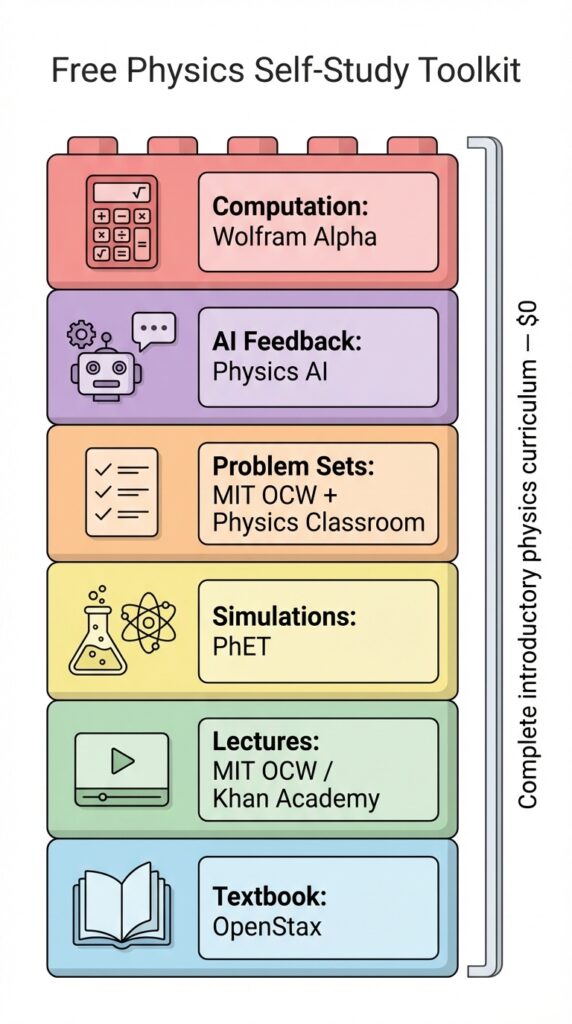
This combination covers the full introductory physics curriculum at a level equivalent to what a first-year student at a research university encounters. The gap between this free stack and a paid university experience lies primarily in two areas: credentialing (no transcript or degree) and human mentorship (no professor to ask nuanced questions). For the purpose of learning the material itself, the gap is narrower than it has ever been.
Which Free Tools Work on Low Bandwidth or Basic Devices?
Text-heavy resources load fastest. HyperPhysics and the HTML version of OpenStax function well on slow connections and older devices. MIT OCW lecture videos can be downloaded for offline viewing via their dedicated app or YouTube’s offline save feature. PhET offers downloadable simulation files that run locally without a persistent internet connection. Physics AI, as a lightweight web-based tool, requires minimal bandwidth per query compared to streaming video.
For learners in regions with limited connectivity, a practical strategy is to batch-download lecture videos and textbook chapters during periods of access, then use text-based tools (HyperPhysics, AI solvers) for day-to-day study.