The best travel destinations for people who care about learning are not always the ones with the most famous universities or the most prestigious cultural institutions. Sometimes they are the places where a society made a deliberate decision about what it valued and built its public life around that decision in ways that are still visible in the streets, the schools, the libraries, and the daily rhythms of the people who live there.
Montevideo, the capital of Uruguay, is that kind of place. In a region where public education has often been underfunded, politically compromised, or simply unavailable to large portions of the population, Uruguay chose a different path. It invested in teachers, in public universities, in technology access for children, and in a civic culture built around the idea that an educated population is the foundation of everything else a country wants to become. The results of that investment are visible in Montevideo in ways that repay attention from anyone who thinks seriously about how learning happens and what conditions support it.
Here are eight reasons the city belongs on the educational traveler’s list.
1. Uruguay Has One of the Highest Literacy Rates in the Americas
Uruguay’s adult literacy rate sits consistently above 98 percent, placing it among the top countries in the Western Hemisphere and well ahead of most of its regional neighbours. This is not a recent achievement produced by a single policy intervention. It reflects over a century of sustained public investment in primary education that dates to the presidency of José Batlle y Ordóñez in the early 20th century, when Uruguay established free, compulsory, secular public schooling as a foundational national commitment.
Walking through Montevideo’s neighbourhoods, from the historic Ciudad Vieja on the tip of the peninsula to the leafy streets of Pocitos and Punta Carretas, you see the physical infrastructure of that commitment: school buildings on almost every other block, public libraries in neighbourhood centres, bookshops with serious stock in residential areas that would support only convenience stores in comparable districts in other regional capitals. The built environment of Montevideo reflects a society that built itself around the expectation that people read.
2. Plan Ceibal Made Uruguay the First Country to Give Every Child a Laptop
In 2007, Uruguay launched Plan Ceibal, a national program providing one laptop per child to every student in public primary school, along with free internet access and teacher training. It was the first country in the world to achieve universal laptop coverage for a public school system, completing the rollout across all primary schools by 2009 and expanding to secondary schools in subsequent years.
The program drew international attention from education researchers and technology policy experts for a decade after its launch, with teams from MIT, UNESCO, and various development organisations studying its implementation and outcomes. The results were mixed in measurable academic terms but unambiguous in terms of connectivity and access: for the first time, children from low-income families in rural Uruguay had the same digital access to educational resources as children in Montevideo’s wealthiest districts. That equity commitment, playing out at national scale in a country of 3.5 million people, is worth understanding in the context of the wider global conversation about digital access in education, which our piece on online learning in the US addresses from a North American angle.
3. The Universidad de la República Is Free and Open to All
The Universidad de la República, Uruguay’s main public university, charges no tuition. No entrance exams are required for most faculties. Any Uruguayan who completes secondary school can enrol. The university has operated on this model since 1849, making it one of the oldest continuously free universities in the Americas.
The main campus in Montevideo’s Centro neighbourhood is a working university city within the city, with faculty buildings, libraries, cafeterias, and student life spread across several blocks of the historic centre. The student population is large, the political culture on campus is active and engaged, and the presence of tens of thousands of students in the daily life of the city gives Montevideo an intellectual energy that is visible in its cafés, its bookshops, and its street-level conversation in a way that distinguishes it from regional capitals where universities are isolated from urban life. Spending an afternoon in the neighbourhood around the law faculty or the social sciences building gives you a sense of what a city looks like when higher education is not a privileged option but a normal expectation.
4. The Mercado del Puerto and the Food Culture Teach Economic History Through the Plate
Uruguay’s prosperity in the late 19th and early 20th centuries was built on cattle and sheep ranching for the European meat and wool markets, and the legacy of that pastoral economy is embedded in the food culture in ways that reward attention. The Mercado del Puerto, an iron-framed market building in the Ciudad Vieja dating from 1868, now operates as a cluster of parrilla restaurants where whole animals are grilled over wood fires in a style that has not changed fundamentally in a century.
Eating a meal at the Mercado del Puerto is also a lesson in how a national economy produces a national cuisine. The quality of the beef is a direct function of the Uruguayan cattle ranching system, which operates at lower density and on better pasture than comparable operations in Brazil or Argentina. The wine served alongside it comes from the Tannat grape, a variety that arrived with Basque immigrant settlers in the 19th century and found in Uruguay’s clay soils a character it had not quite managed in its French homeland. These are not incidental details. They are the material record of a country’s economic and demographic history, legible on the plate.
5. Montevideo’s Cultural Institutions Are Accessible and Serious
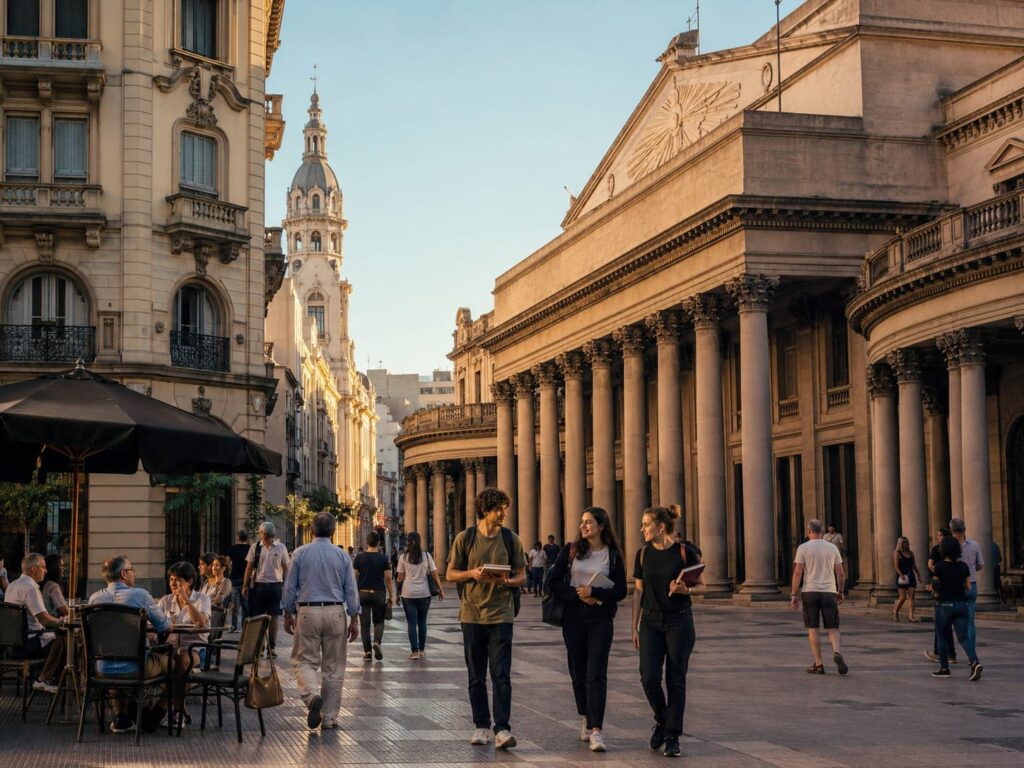
The Teatro Solís, Montevideo’s main opera and theatre venue, opened in 1856 and is one of the finest 19th-century theatre buildings in South America. Entry to many of its public events is free or low-cost. The Museo Nacional de Artes Visuales in the Parque Rodó holds the largest collection of visual art in Uruguay, with works spanning from colonial religious painting to contemporary Uruguayan and international artists, and charges no admission. The Biblioteca Nacional, the national library on Avenida 18 de Julio, is a working research library open to the public.
This pattern of accessible, funded, public cultural infrastructure is not common in the region. It reflects the same philosophical commitment to public access that produced the free university and the universal literacy program. For educational travelers who want to understand how a society translates its values into physical institutions, an afternoon moving between the Teatro Solís, the Museo Nacional, and the Biblioteca Nacional covers that question more directly than any number of guidebook descriptions.
6. Guided Tours Connect the History to the Visible Present
Montevideo’s history is layered in ways that are not always legible from the street. The colonial fortifications of the Ciudad Vieja sit alongside 19th-century commercial architecture, Art Deco office buildings from the 1930s, and Modernist housing blocks from the mid-20th century, all within a few blocks of each other. The political history of the 20th century, including the military dictatorship of 1973 to 1985 and its legacy in Uruguayan society, is present in the city’s memorials, its public spaces, and the conversations of its residents, but requires context to read accurately.
Operators like Montevideo Uruguay Tours offer guided experiences that move through the city’s architectural and political history, connecting the physical environment to the social decisions that shaped it across two centuries. For educational travelers whose interest in Montevideo extends beyond its beaches and restaurants to the story of how Uruguay became what it is, this kind of contextual guidance transforms a pleasant city walk into a substantive historical education.
7. Uruguay’s Progressive Policy Record Is a Case Study in Evidence-Based Governance
Uruguay legalised same-sex marriage in 2013, became the first country to fully legalise and regulate the cannabis market in 2013, and has maintained a consistently high ranking on press freedom, judicial independence, and anti-corruption indices for decades. These are not accidental outcomes. They reflect a political culture shaped by the Batllista tradition of pragmatic, reform-oriented governance that treats public policy as a problem to be solved with available evidence rather than a battleground for ideological expression.
For learners interested in comparative politics, governance models, or public policy, Uruguay is a live case study in how a small, middle-income country with limited natural resources and a history of political instability can produce stable, progressive institutions through sustained commitment to democratic norms and evidence-based reform. The outcomes are visible in the country’s education statistics, its healthcare access figures, its income distribution data, and in the daily life of its capital city in ways that repay direct observation.
8. The Rambla and the Café Culture Support the Kind of Thinking That Learning Requires
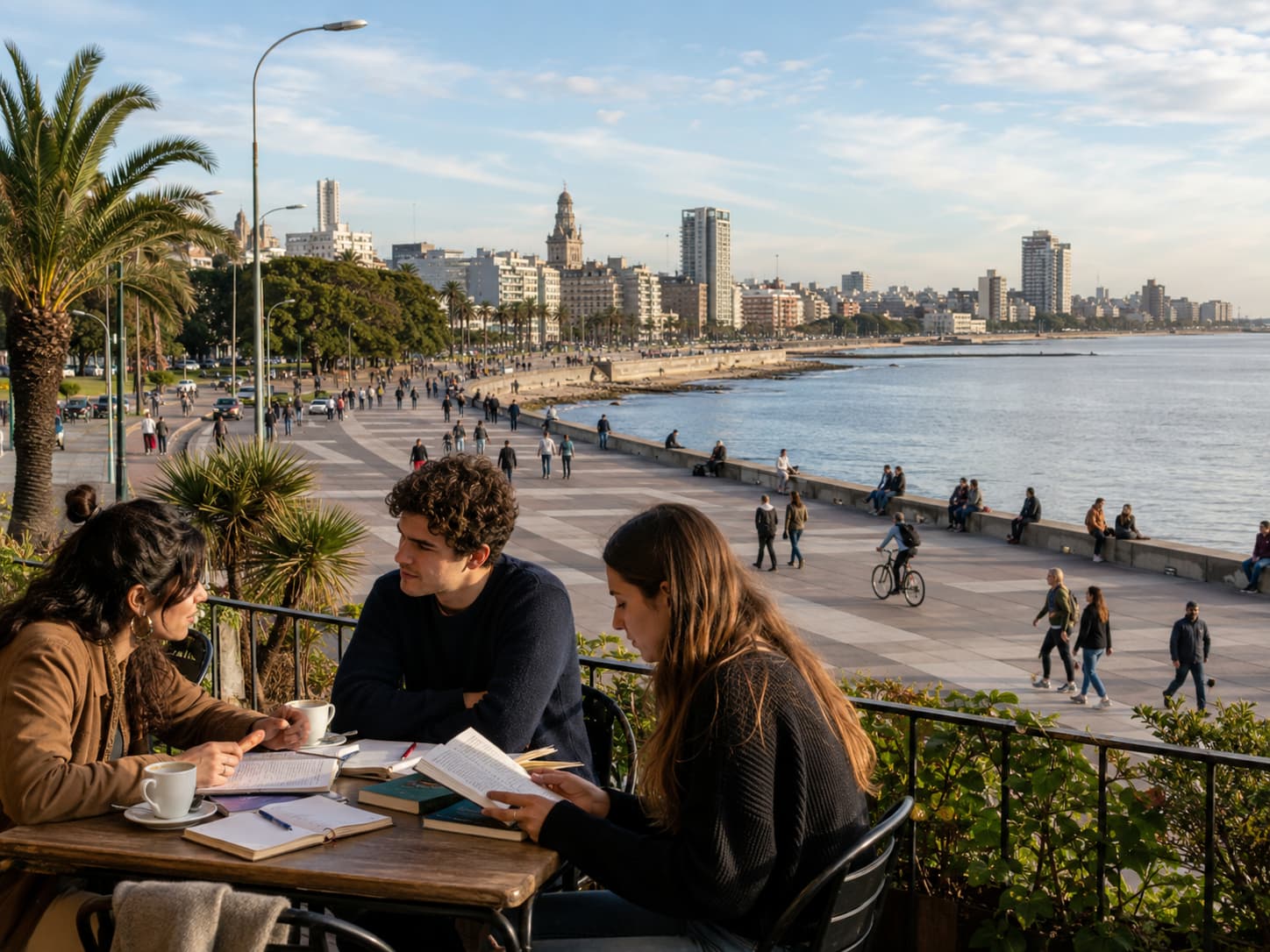
Montevideo’s Rambla, the 22-kilometre coastal promenade that runs along the Río de la Plata from the Ciudad Vieja to the eastern suburbs, is one of the great urban walking environments in South America. It passes through a dozen distinct neighbourhoods, each with its own character, and is used daily by residents of all ages and backgrounds for walking, running, cycling, fishing, and the specific kind of unhurried conversation that the Uruguayan café culture produces at the tables that line the route.
The connection between physical movement, outdoor environment, and cognitive performance is well-established in the learning science literature, and the effective study habits research consistently supports the value of breaks that involve movement and environmental change for maintaining focus and retention over longer learning sessions. The Rambla provides this at urban scale. A morning walk from the Ciudad Vieja to Pocitos and back, with a coffee stop at one of the mirador cafés overlooking the river, is the kind of active rest that online learners and knowledge workers tend to shortchange themselves on, and Montevideo makes it the default rather than the exception.
A Final Thought
Educational travel at its best is not about visiting famous universities or attending lectures in foreign languages. It is about going to places where a society made choices and those choices are still visible in the streets, the schools, the libraries, the food, and the conversations of the people who live there. Montevideo made its choices early and held to them through considerable political and economic difficulty, and the result is a city that functions as a working argument for the idea that public investment in education and culture produces a better kind of urban life.
That argument is worth going to see in person. The Rambla walk, the free university campus, the Teatro Solís on a Tuesday evening, the conversation at the café table: these are the materials of the case. Montevideo makes them available to anyone who shows up with enough time and attention to read them.
That turns out to be enough.